
Know What’s in Your Peptide Vial!!!

Real-world testing on Retatrutide vial (Reta, GLP3)
What is wrong with this Certificate of Analysis?
Understanding the Role of Peptide in Research
The importance of studying peptide interactions in various biological systems cannot be overstated, as it directly influences therapeutic developments related to peptide-based treatments.
Understanding the bioactivity of peptide sequences can lead to breakthroughs in drug design.
Research on peptide mechanisms continues to evolve, shedding light on their potential applications in regenerative medicine.
The role of peptide purity in experimental outcomes is critical; impurities can significantly alter the results.
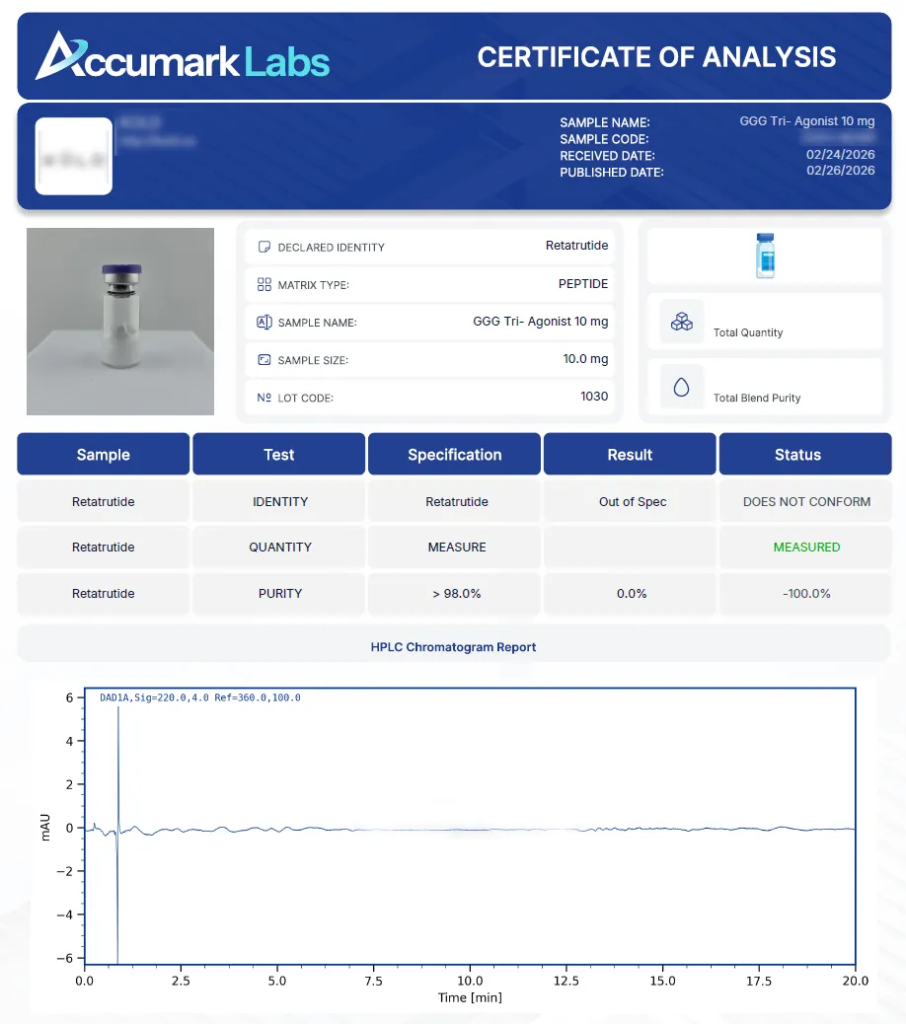
This visual evidence serves as a stark warning for the research community. While the Certificate of Analysis (COA) appears impeccably professional at first glance—with its standardized formatting, laboratory logos, and quantitative tables—the underlying analytical data unequivocally reveals a vial containing absolutely no detectable active pharmaceutical ingredient (API). As we progress through 2026, the unregulated “grey market” for synthetic research peptides, particularly metabolic tri-agonists like Retatrutide , has undergone exponential expansion driven by surging demand for GLP-1 receptor, glucose-dependent insulinotropic polypeptide (GIP), and glucagon receptor modulators. This growth has been accompanied by a parallel proliferation of sophisticated adulteration and counterfeiting techniques. Accurate, independent orthogonal testing remains the sole robust line of defense for safeguarding the integrity of preclinical or in vitro research models.
The Reality of the “Empty Vial” (Ghost Vial Phenomenon)
The exemplar COA for Retatrutide demonstrates a reported purity of 0.0% (determined via reverse-phase high-performance liquid chromatography, RP-HPLC, with ultraviolet detection at 214 nm or 280 nm using area-under-the-curve normalization) and a non-conformance status explicitly flagged as “DOES NOT CONFORM.” Examination of the accompanying chromatogram reveals a perfectly flat baseline trace with no discernible absorbance peak at the expected retention time (typically 8–12 minutes under standard C18 column conditions with acetonitrile-water-trifluoroacetic acid gradients). This absence of any ultraviolet-active polypeptide signal, coupled with electrospray ionization mass spectrometry (ESI-MS) data showing no protonated molecular ion ([M+H]⁺) at the predicted m/z for the 39-amino-acid sequence of Retatrutide, confirms the complete lack of the target analyte. Such “ghost vials” are not merely anecdotal; they represent a deliberate e-commerce scam vector wherein vendors ship lyophilized vials containing only inert excipients (e.g., mannitol or trehalose bulking agents) or, in extreme cases, vacuum-sealed empty glassware.
Improper peptide identification can result in unexpected biological effects, complicating the research process.
Many researchers are turning to comprehensive peptide profiling to ensure accuracy in their findings.
Independent market surveillance and forensic testing of peptides procured from popular unregulated online research chemical vendors reveal severe quality shortfalls. Systematic analyses have shown that only approximately 38% of sampled products meet even basic purity thresholds (≥95% by HPLC-UV). In targeted evaluations of high-demand GLP-1 analogues like semaglutide (often used as a proxy for the broader metabolic peptide class), a 2024 study published in *JAMA Network Open* found that products purchased from illegal online pharmacies without a prescription contained semaglutide but exhibited drastically reduced purity levels ranging from 7% to 14%—compared with the 99% purity claimed by sellers—while the actual semaglutide content exceeded the labeled amount by 29% to 39%. These findings underscore how vendor-claimed purities of 99% contrast sharply with actual measured polypeptide content (sometimes as low as 7.7%), with over 85–92% of vial contents consisting of unidentified low-mass compounds or fillers. Broader surveillance further documents that up to 50% or more of tested vials from unverified sources deviate substantially from labeled concentrations (sometimes by ±28–39% or worse), while a significant fraction harbor detectable microbial contaminants or process-related impurities such as bacterial endotoxins (quantified via kinetic chromogenic Limulus Amebocyte Lysate, LAL, assay, often exceeding safe research thresholds). These observations align with repeated U.S. Food and Drug Administration (FDA) alerts documenting that counterfeit or illicitly marketed “research-use-only” peptides—including semaglutide, tirzepatide, and retatrutide—may contain no active ingredient whatsoever, posing direct risks to experimental reproducibility, biosafety, and model organism health.
Independent verification of peptide samples is essential for maintaining research integrity.
Worse Than a Scam: The Mislabeled Vial and Sequence Adulteration
Financial loss from an empty vial is inconvenient, yet the insidious hazard of mislabeling poses far greater threats to data validity and model organism safety. Receiving a structurally dissimilar peptide (e.g., a potent anorectic mono-agonist when a growth hormone secretagogue was ordered) can induce off-target receptor activation, confounding downstream assays such as cAMP accumulation, β-arrestin recruitment, or in vivo metabolic phenotyping. Forensic sequence verification via liquid chromatography-tandem mass spectrometry (LC-MS/MS) peptide mapping—encompassing precursor ion selection, collision-induced dissociation fragmentation, and database matching of b- and y-ions—frequently uncovers primary structure mismatches in grey-market samples. Emerging data from vendor-agnostic testing programs flag such identity failures in a non-negligible subset of shipments, often compounded by the presence of truncated fragments, diastereomeric impurities, or entirely unrelated sequences arising from synthesis scale-up errors in unregulated facilities.
The FDA has issued repeated warnings regarding unapproved GLP-1-class compounds falsely labeled for “research purposes,” noting that such products may incorporate incorrect active moieties, toxic byproducts, or sub-potent formulations that deviate markedly from labeled claims. Multi-year monitoring of e-commerce and social-media peptide marketplaces documents a sustained surge in problematic listings, with online advertisements for such products increasing dramatically since 2022, alongside substantial growth in e-commerce marketplace listings.
Utilizing high-resolution techniques for peptide analysis can dramatically enhance the reliability of results.
The Imperative for Independent Verification: Accumark Labs as the Gold Standard
Ensuring the correct peptide composition is foundational for experimental reproducibility.
Researchers must remain vigilant regarding the quality of peptide products to avoid compromising their studies.
Vendor-supplied COAs are inherently unreliable—analogous to an examinee self-grading their own examination paper—because they lack the impartiality required for defensible science. Seller-provided documentation can be digitally fabricated (e.g., photoshopped HPLC traces or generic mass spectra without raw data files or QR-linked batch traceability). This is precisely why independent, ISO-aligned third-party laboratories like Accumark Labs (accumarklabs.com) have become the de facto standard for rigorous peptide qualification among discerning researchers.
By submitting a blinded subsample from any batch for orthogonal analysis, investigators obtain:
1. Quadrupole time-of-flight liquid chromatography-mass spectrometry (QTOF LC-MS), coming online in April 2026, to verify exact monoisotopic mass (within ±0.01 Da tolerance) and full sequence coverage via high-resolution MS/MS fragmentation spectra.
2. **Quantitative Purity Assessment** — RP-HPLC with photodiode array (PDA) detection and optional evaporative light-scattering detection (ELSD) for non-chromophoric impurities; purity reported as percentage of target peak area relative to total integrated absorbance, with limits of detection (LOD) routinely below 0.1%.
3. **Biosafety and Impurity Profiling** — Kinetic LAL endotoxin testing (<0.5 EU/mg threshold for research-grade material), sterility assessment per USP <71>, and residual solvent analysis (e.g., trifluoroacetic acid or acetonitrile via headspace gas chromatography) to exclude pyrogenic or cytotoxic contaminants that vendor COAs routinely omit.
Accumark Labs operates with a rapid 48–72-hour turnaround, issues tamper-evident reports with live verification badges, and maintains complete independence—issuing unequivocal “DOES NOT CONFORM” verdicts without commercial incentive to pass failing material, as demonstrated in the provided Retatrutide example.
Bottom Line
In the 2026 peptide ecosystem—where online advertising has increased dramatically and unregulated imports continue to proliferate—a polished website, customer testimonials, or even a vendor COA offers zero evidentiary value. Without batch-specific verification through an independent laboratory such as Accumark Labs, researchers are not conducting controlled experimentation; they are performing uncontrolled, potentially hazardous bioassays on unknown chemical entities. Prioritize analytical rigor: confirm identity, purity, and biosafety before any vial enters the laboratory workflow. Your data—and your models—depend on it.


Get Your Peptides Analyzed
Fixed pricing. Fast turnaround. Verified results with cryptographic proof.